How Does Solar Energy Actually Work? A Simple Step-by-Step Guide

How Does Solar Energy Actually Work A Simple Step-by-Step Guide-main

You’ve probably seen solar panels on rooftops across your city – homes, factories, schools. Maybe you’ve thought about going solar yourself. There’s always that one question: how exactly does sunlight turn into electricity that powers my fans, ACs, and appliances?

What Is Solar Energy?

Solar energy is energy from the sun. The sun radiates an enormous amount of light every single day, and solar panels are designed to capture that light and convert it into usable electricity.

What makes it special is that it’s free and doesn’t run out. No one charges you for sunlight. Once installed, you’re generating your own power – cleanly, right from your rooftop.

How Solar Energy Works: Step by Step

The activity was straightforward and participatory. The team came together at our facility, and potted plants and rope-hanging plants were distributed among employees, as well as the visitors, partners, and stakeholders who were part of the day.

A tree-planting activity was also carried out on the premises, with team members planting saplings together. Inside the office, leadership personally handed plants to employees – a small but deliberate gesture that made the occasion feel more personal. Employees also carried their plants during a walkthrough near the facility, making the activity more collective and visible.

The atmosphere was relaxed and positive throughout. People talked, took photographs, and left with something they could actually grow and care for.

How Solar Energy Works Step by Step

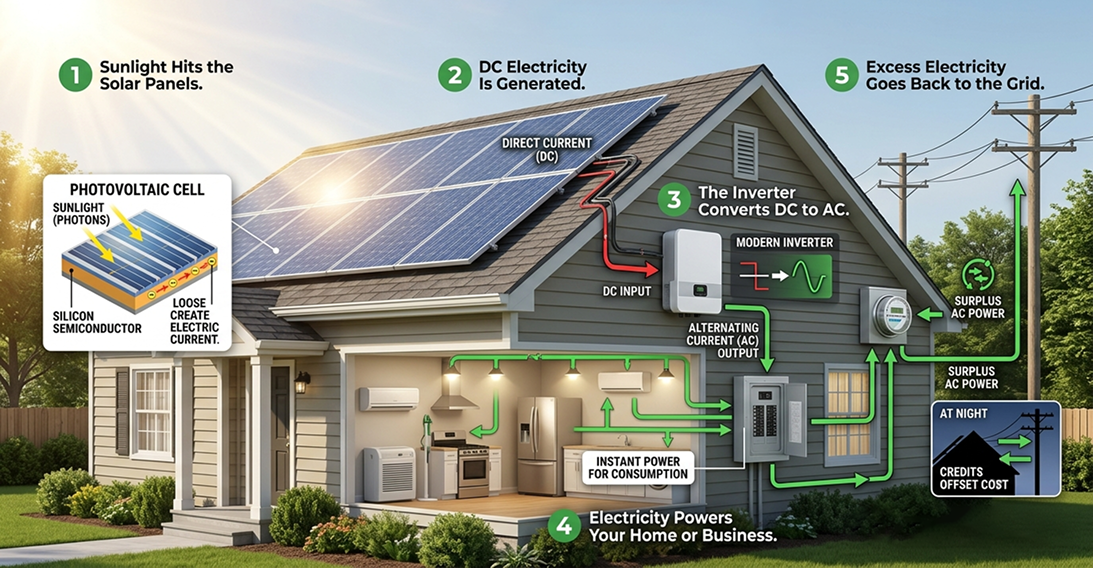
It starts on your rooftop. Solar panels are made up of small units called photovoltaic (PV) cells, built from silicon – a semiconductor material that reacts when light hits it. When sunlight strikes a cell, it knocks electrons loose. Those moving electrons create an electric current.

The quality of that reaction depends on the panel technology used. High-efficiency TOPCon modules, like those manufactured by ISH Solar, capture more sunlight and convert it more effectively – giving you more power from the same roof area.

The current produced is called Direct Current (DC) electricity. Your home appliances don’t run on DC though – they run on Alternating Current (AC). So it needs one more step.

The inverter is one of the most critical parts of any rooftop solar system. It converts DC into AC – the kind your lights, refrigerator, and air conditioner use. Modern inverters also monitor performance in real time.

Once converted, electricity flows into your home just like regular grid power. Your appliances don’t care whether power came from the utility or your rooftop. During the day, solar covers your consumption directly. 

On sunny days, your panels often generate more than you actually use. That surplus doesn’t go to waste – it flows back into the grid through net metering. Your utility company credits you for every unit you export. At night, you draw from the grid, and those credits offset the cost.

Key Components of a Solar Energy System

A rooftop solar system has a few essential parts working together:

Solar Panels:

Capture sunlight and generate DC electricity

Inverter:

Converts DC to AC for home use

Net Meter:

Tracks energy exported to and received from the grid

Mounting Structure:

Holds panels securely on your roof

Wiring & Distribution Board:

Connects everything to your electrical system

Some systems also include a battery for storing excess electricity – useful during power cuts or at night. The foundation of all of this, however, is the panel itself. A high-performance module determines how well your entire system performs over its lifetime.

Why Understanding This Helps You

When you know how your system works, you make smarter decisions. Running heavy appliances during daylight hours reduces what you pull from the grid. Small habit changes, bigger savings. It also helps you ask better questions before buying – like what panel technology is being used and what the warranty terms are.

Common Misconceptions About Solar

"Solar panels don't work on cloudy days." They do - panels respond to diffused sunlight, not only direct sunshine.

"Solar is only for large homes or factories." Systems can be sized for a small apartment as easily as a large commercial setup.

"Once installed, you can't use grid power." You can. A grid-tied system keeps you connected - solar only reduces what you draw.

"Panels need constant maintenance." Occasional cleaning and a yearly inspection are all that's needed.

Conclusion

Solar energy works because of a simple chain: sunlight hits panels, electrons move, electricity flows.

Whether you’re a homeowner cutting electricity bills or a business owner reducing costs, understanding this process helps you decide with confidence.

At ISH Solar, we build high-efficiency solar modules designed to perform reliably across residential, commercial, and industrial applications. If you’re ready to start your solar journey, get in touch with our team.

Frequently Asked Questions (FAQs)

How much electricity can a rooftop solar system generate?

A 1 kW system generates roughly 4-5 units per day. Home systems typically range from 3 kW to 10 kW.

Do solar panels work at night?

No – panels need sunlight to generate power. At night, you draw from the grid or from a battery if included.

What is net metering?

Net metering lets you export unused solar electricity to the grid and earn credits on your bill.

How long do solar panels last?

Most quality panels carry a 25-year performance warranty and remain functional well beyond it.

Is a battery necessary?

Not always. With reliable grid access and net metering available, a battery isn’t essential – it adds value mainly during power cuts.

Will solar work on my roof type?

Panels work on most rooftops – RCC, tin, or sloped. The main requirement is shadow-free, south-facing area.

How soon will I recover my investment?

Payback periods in India range from 4 to 6 years, depending on system size, tariffs, and subsidies.

RELATED POSTS

How Does Solar Energy Actually Work A Simple Step-by-Step Guide

How Does Solar Energy Actually Work? A Simple Step-by-Step Guide

You’ve probably seen solar panels on rooftops across your city – homes, factories, schools. Maybe you’ve thought about going solar yourself. There’s always that one question: how exactly does sunlight turn into electricity that powers my fans, ACs, and appliances?
This year, we decided to keep things simple. On June 5th, 2026, ISH Solar celebrated World Environment Day by distributing small potted plants and rope-hanging plants to our employees, visitors, partners, and stakeholders. No elaborate arrangements – just a straightforward activity that carried a clear message. Taking care of the environment does not always require big moves. Sometimes it starts with something as small as a plant on your desk.

How Ish Solar's Bifacial Technology Captures the Lost Energy of the Ground-featured

How Ish Solar’s Bifacial Technology Captures the Lost Energy of the Ground

When you start any new business or adopt any new strategy, the profit expectation becomes 0. Among all these, solar is the only investment that can give you profit from day one. Suppose you started a business for a hundred rupees, will that business earn 130 rupees from the first day? We know your answer will be no. So it’s not too late. If you are still paying expensive electricity bills every month and killing your dreams, then Ish Solar is ready to get you out of this problem. So far, we have only seen that solar panels generate electricity from the top, that is, from direct sunlight. Instead of hitting the panels, thousands of sun rays hit the surrounding ground, roof surfaces, or sand, becoming waste. This is energy that no one has been able to capture until now.

Why Ish Solar Modules Deliver Better Returns Than an FD in 2026-featured

Why Ish Solar Modules Deliver Better Returns Than an FD in 2026

Leave the old tradition, move with the times and be smart. Are you still investing in fixed deposits? Just think about how much investment and what is the return. In this blog, we will learn how Ish Solar’s high-quality panel modules give you more returns than the bank. Don’t get caught up in the FD cycle, this is the era of solar, adopt solar.