

Solar Module Certifications Explained: Why ALMM, BIS & IEC Standards Matter Before You Buy

Solar Module Certifications Explained Why ALMM, BIS & IEC Standards Matter Before You Buy-main

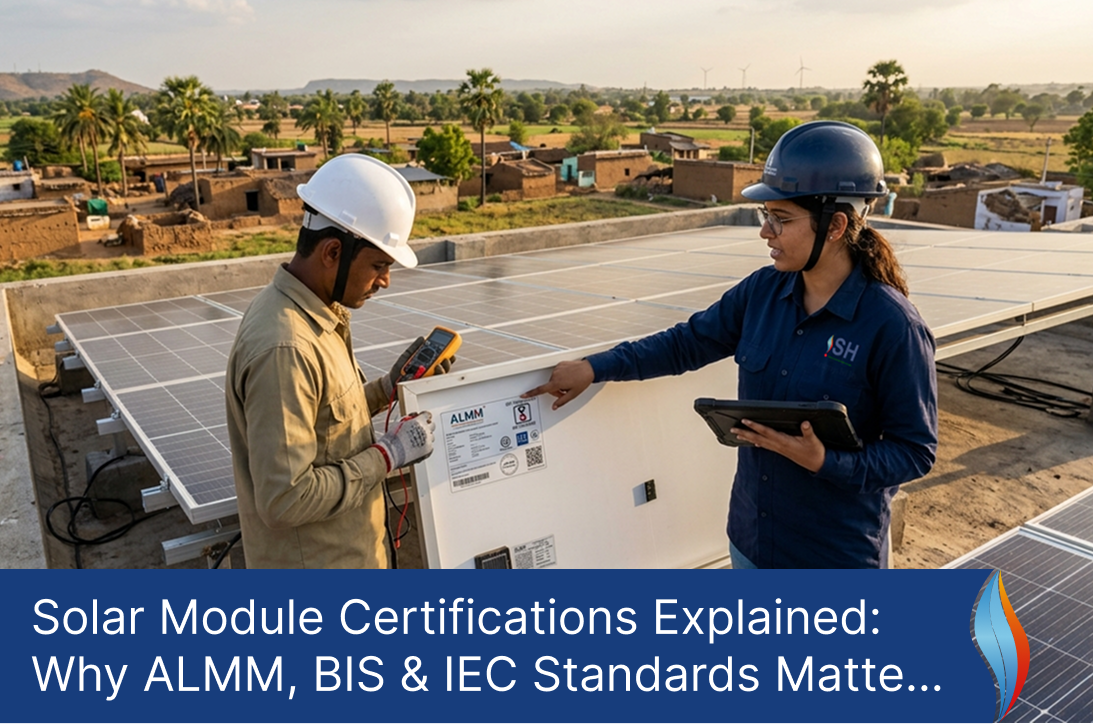
Most solar buyers compare price and warranty and stop there. What often gets missed is whether a module is even legally eligible for subsidy or a government-linked project in India. That comes down to three standards: ALMM, BIS, and IEC.

ALMM

ALMM: The List That Decides Subsidy Eligibility

ALMM, the Approved List of Models and Manufacturers maintained by MNRE, isn't a quality certification, it's a mandatory registry. A module not on the list can't be used in PM Surya Ghar, SECI tenders, or most government-funded projects. List-I covers finished modules, and List-II covers the cells inside them, which is where domestic content compliance comes in.

BIS: India's Mandatory Quality Gate

BIS certifies crystalline silicon modules under IS 14286, a standard aligned with IEC but enforced domestically. It requires lab testing plus a factory inspection to confirm consistent production at scale, not just one good sample batch. A BIS licence also covers specific module models, not a manufacturer's entire catalogue.

IEC

IEC: The International Baseline

IEC 61215 and IEC 61730 are the international tests that IS 14286 is built on. IEC 61215 checks durability, thermal cycling, mechanical load, humidity, while IEC 61730 checks electrical safety. These represent the minimum bar any credible module should clear before being sold anywhere.

How ISH Solar Meets These Standards

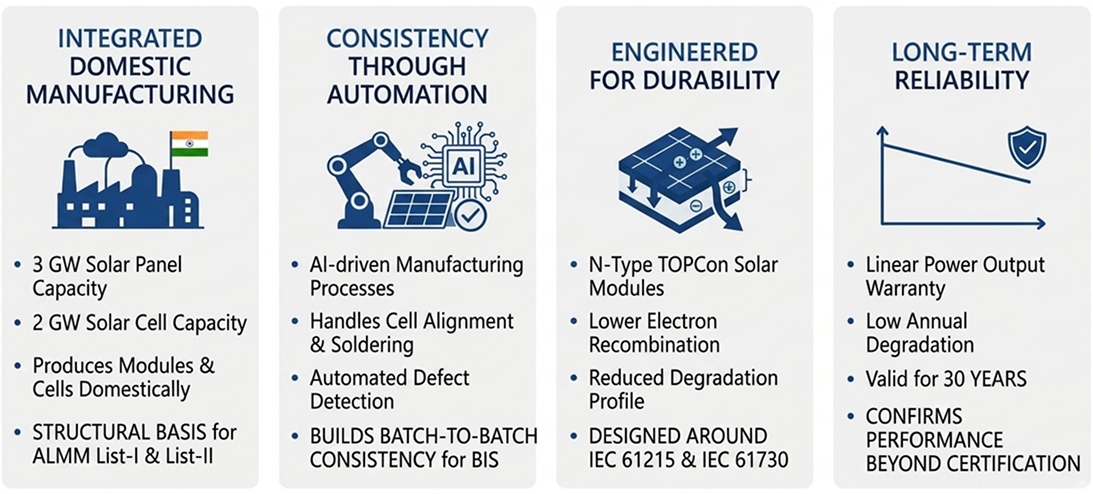
ISH Solar is an Indian solar cell and solar module manufacturer built around this compliance from the manufacturing floor itself, not as paperwork added at the end. With a 3 GW solar panel manufacturing capacity and 2 GW solar cell manufacturing capacity, the company produces both modules and cells domestically, which is the structural basis ALMM’s List-I and List-II eligibility is checked against. Its AI-driven manufacturing processes handle cell alignment, soldering precision, and defect detection through automated checks at every stage, which is what makes the kind of batch-to-batch consistency BIS factory inspections look for possible at that scale. Its N-Type TOPCon solar modules are engineered around the durability profile IEC 61215 and IEC 61730 test for, since TOPCon’s lower electron recombination and reduced degradation directly support long-term performance rather than just clearing a minimum threshold. Every module also carries a long-term linear power output warranty and low annual degradation over 30 years, which is what confirms performance continues well beyond the point where certification testing stops.

How ISH Solar Meets These Standards

Conclusion

ALMM, BIS, and IEC decide whether a module is legally eligible for your project and whether it performs as claimed. ISH Solar builds this in from the manufacturing floor, backed by 3 GW panel and 2 GW cell capacity, AI-driven consistency, and TOPCon modules engineered for long-term performance. Get in touch with ISH Solar for panels built around these standards from the ground up.

Frequently Asked Questions (FAQs)

Are ISH Solar's modules built to meet BIS and IEC standards?

ISH Solar’s AI-driven, consistent manufacturing supports meeting IS 14286 and IEC 61215/61730 requirements at scale.

Does ISH Solar manufacture both cells and modules for ALMM List-II compliance?

Yes, with a 3 GW solar panel and 2 GW solar cell manufacturing capacity covering both List-I and List-II requirements.

Why does ISH Solar use AI-driven manufacturing?

It supports the batch-to-batch consistency that certification testing and factory inspections check for.

Are ISH Solar's N-Type TOPCon modules suited for long-term, certified projects?

Yes, TOPCon’s lower degradation and higher efficiency align with the durability standards IEC and BIS testing evaluate.

What warranty backs ISH Solar's modules?

A long-term linear power output warranty and product warranty, with low annual degradation over 30 years.

Is ISH Solar a domestic, Made in India manufacturer relevant to ALMM?

Yes, ISH Solar’s manufacturing is based in India, supporting Made in India modules and ALMM’s domestic content basis.

RELATED POSTS

How Does Solar Energy Actually Work A Simple Step-by-Step Guide

How Does Solar Energy Actually Work? A Simple Step-by-Step Guide

You’ve probably seen solar panels on rooftops across your city – homes, factories, schools. Maybe you’ve thought about going solar yourself. There’s always that one question: how exactly does sunlight turn into electricity that powers my fans, ACs, and appliances?
This year, we decided to keep things simple. On June 5th, 2026, ISH Solar celebrated World Environment Day by distributing small potted plants and rope-hanging plants to our employees, visitors, partners, and stakeholders. No elaborate arrangements – just a straightforward activity that carried a clear message. Taking care of the environment does not always require big moves. Sometimes it starts with something as small as a plant on your desk.

More Panels, Lower Price - But Is It Actually a Better Deal-featured

More Panels, Lower Price – But Is It Actually a Better Deal?

You have three solar quotations in front of you. One offers 10 kW for a price that seems almost too good. Another proposes 8 kW from a brand you recognise, with a longer warranty and a proper site survey included. The third is somewhere in the middle – more panels, vague warranty terms, and a salesperson emphasising system size over actual generation.