





17.5 GW and Counting: How India's Rooftop Solar Boom Is Reshaping Residential Energy

17.5 GW and Counting How India's Rooftop Solar Boom Is Reshaping Residential Energy-main

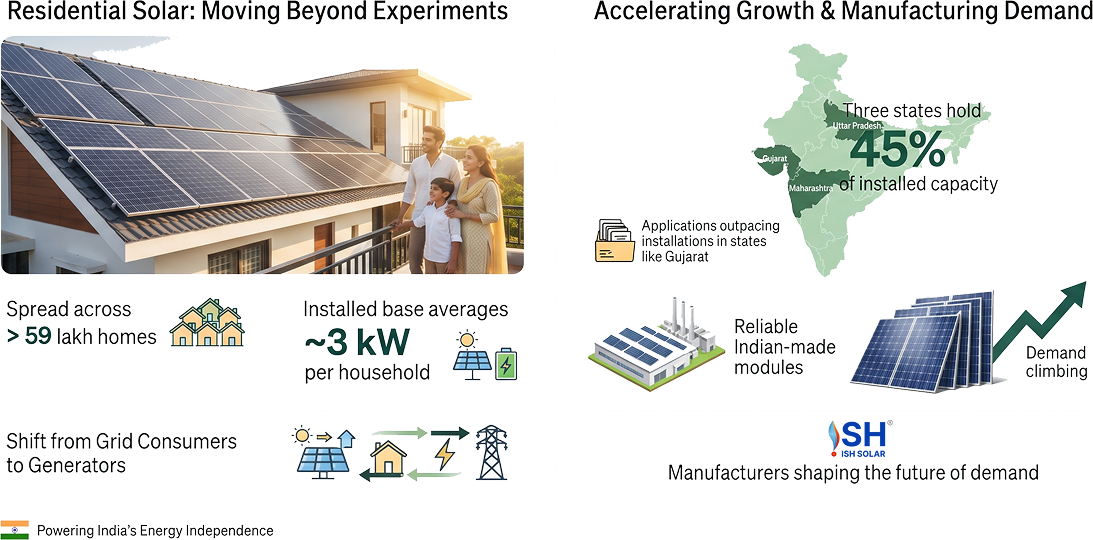
India’s residential rooftop solar capacity under the PM Surya Ghar: Muft Bijli Yojana has crossed 17,500 MW, covering more than 59 lakh households. The headline number is impressive, but the bigger story is what sits underneath it. Millions of homes now depend on rooftop systems for years of power and savings, and that puts the spotlight on the modules doing the work. This is where ISH Solar comes in.

From Subsidy Scheme to Everyday Energy

Residential solar has moved from an experiment to a household habit. Spread across more than 59 lakh homes, the installed base averages roughly 3 kW per household, enough to change how a family thinks about its electricity bill. Homes are shifting from consumers of grid power to generators of their own, and each rooftop adds to national energy independence. Reliable hardware is what turns that choice into long-term savings.

Growth at this pace also raises the bar. Applications are outpacing installations in states like Gujarat, and three states, Uttar Pradesh, Maharashtra and Gujarat, hold 45 per cent of installed capacity. As adoption spreads to more states, the demand for dependable Indian-made modules, backed by strong manufacturing capacity, keeps climbing. Manufacturers such as ISH Solar will shape how well that demand is met.

From Subsidy Scheme to Everyday Energy

Where ISH Solar Fits In

ISH Solar is an Indian solar module and solar cell manufacturer, and a rooftop boom of this size is exactly the kind of demand its manufacturing is built for. ISH Solar operates 2 GW of solar panel manufacturing capacity and 1 GW of solar cell manufacturing capacity, giving it the scale to support residential, commercial, industrial and utility-scale projects.

For homes, ISH Solar offers residential and commercial solar modules alongside its N-Type TOPCon and high-efficiency PV module range. AI-driven precision manufacturing keeps quality consistent from one ISH Solar module to the next, which matters when a household trusts a rooftop system for decades. ISH Solar modules are designed for low first-year degradation and low annual degradation over 30 years, backed by a linear power output warranty and a product warranty. They are built to deliver consistent power generation under diverse environmental conditions.

Customers also receive expert technical guidance, project consultation and product support from ISH Solar, so the journey from enquiry to energy generation stays clear at every step. Innovation sits at the core of ISH Solar's philosophy, with continuous product improvement and sustainable manufacturing practices guiding every production line. With Made in India manufacturing, ISH Solar contributes directly to the country's clean energy growth.

What Homeowners Should Look For

Cell technology

Cell technology:

N-Type TOPCon modules, like those from ISH Solar, deliver high efficiency and stable generation over time.

Degradation:

Low first-year and annual degradation protect output in year thirty as much as in year one.

Warranty

Warranty:

A linear power output warranty plus a product warranty gives long-term security.

Manufacturing quality

Manufacturing quality:

Consistent output starts on the production line, with controlled, technology-led processes.

Support

Support:

A manufacturer that offers technical guidance and consultation makes the decision easier.

The Road Ahead

The 17.5 GW milestone is a foundation, not a finish line. The next phase is turning a deep application pipeline into working rooftops, and that depends on quality modules and reliable manufacturers. That is the standard ISH Solar works to meet with every module it ships. ISH Solar is committed to that future through innovation, quality and reliability, supporting homes, businesses and ground-mounted projects as India moves toward a cleaner, more energy-independent tomorrow.

Frequently Asked Questions (FAQs)

What does India's rooftop solar growth mean for homeowners?

Solar is becoming a mainstream household choice. With more than 59 lakh homes already covered, buyers can now compare technologies, warranties and manufacturers before they decide.

Why does module quality matter for a rooftop system?

A rooftop system runs for decades. Efficiency and degradation rates decide how much energy a home generates in year one and in year thirty.

What does ISH Solar manufacture?

ISH Solar manufactures N-Type TOPCon solar modules, high-efficiency PV modules, utility-scale modules, and residential and commercial modules.

What is ISH Solar's manufacturing capacity?

ISH Solar has 2 GW of solar panel manufacturing capacity and 1 GW of solar cell manufacturing capacity.

Are ISH Solar modules suitable for home rooftops?

Yes. ISH Solar makes residential and commercial modules for rooftop systems, along with modules for industrial and ground-mounted projects.

What warranty do ISH Solar modules carry?

ISH Solar modules carry a linear power output warranty and a product warranty, with low first-year degradation and low annual degradation over 30 years.

RELATED POSTS

Why Ish Solar Modules Deliver Better Returns Than an FD in 2026-featured

Why Ish Solar Modules Deliver Better Returns Than an FD in 2026

Leave the old tradition, move with the times and be smart. Are you still investing in fixed deposits? Just think about how much investment and what is the return. In this blog, we will learn how Ish Solar’s high-quality panel modules give you more returns than the bank. Don’t get caught up in the FD cycle, this is the era of solar, adopt solar.


Solar Panels Alone Don't Create Sustainability - Smart Planning Does-featured

Solar Panels Alone Don’t Create Sustainability – Smart Planning Does

A warehouse owner in Pune installed a 150 kW rooftop solar system two years ago. Savings looked great on paper. Installation happened fast. Nobody spent much time on the roof beforehand. Within eighteen months, panels had hot spots, the roof was leaking around brackets, and output was 22% below projections.