More Panels, Lower Price - But Is It Actually a Better Deal?

More Panels, Lower Price - But Is It Actually a Better Deal-1

You have three solar quotations in front of you. One offers 10 kW for a price that seems almost too good. Another proposes 8 kW from a brand you recognise, with a longer warranty and a proper site survey included. The third is somewhere in the middle – more panels, vague warranty terms, and a salesperson emphasising system size over actual generation.

This is the decision most Indian solar buyers face today. And increasingly, the smarter ones are not choosing on price or panel count alone.

The Market Has Changed

A few years ago, most solar conversations in India started and ended with cost per watt. Customers wanted the biggest system for the lowest price, and installers competed almost entirely on that basis. That dynamic has shifted.

Today’s buyers – homeowners, factory operators, commercial property owners – arrive with better questions. They understand that a cheaper system installed poorly on an under-surveyed rooftop can underperform for 25 years. They are no longer impressed by large kW numbers that do not translate into realistic generation.

Why Quantity Alone Is Misleading

More panels do not automatically mean more savings. A rooftop with shading, poor orientation, or structural limitations will not perform better simply because someone packed extra modules onto it. Forcing more panels into a poorly designed layout can actually increase mismatch losses, reducing output below what a smaller, well-designed system would have delivered.

Cheap panels degrade faster – losing a higher percentage of output each year. At year ten, a system built on cut-price modules may be generating 15% to 20% less than projected, while a quality installation holds its performance curve close to original estimates. That gap compounds significantly across a 25-year project life.

Installation quality matters equally. Improper mounting, undersized cabling, incorrect inverter sizing, and poor earthing are invisible at commissioning but show up consistently in underperformance and expensive remediation later.

What Modern Buyers Actually Prioritise

The shift in buyer priorities is visible in the questions now being asked. Customers want to know degradation rates, not just rated wattage. They ask about inverter brand and local service support. They want to understand what the warranty actually covers and whether the company will still be reachable in year seven when something needs attention.

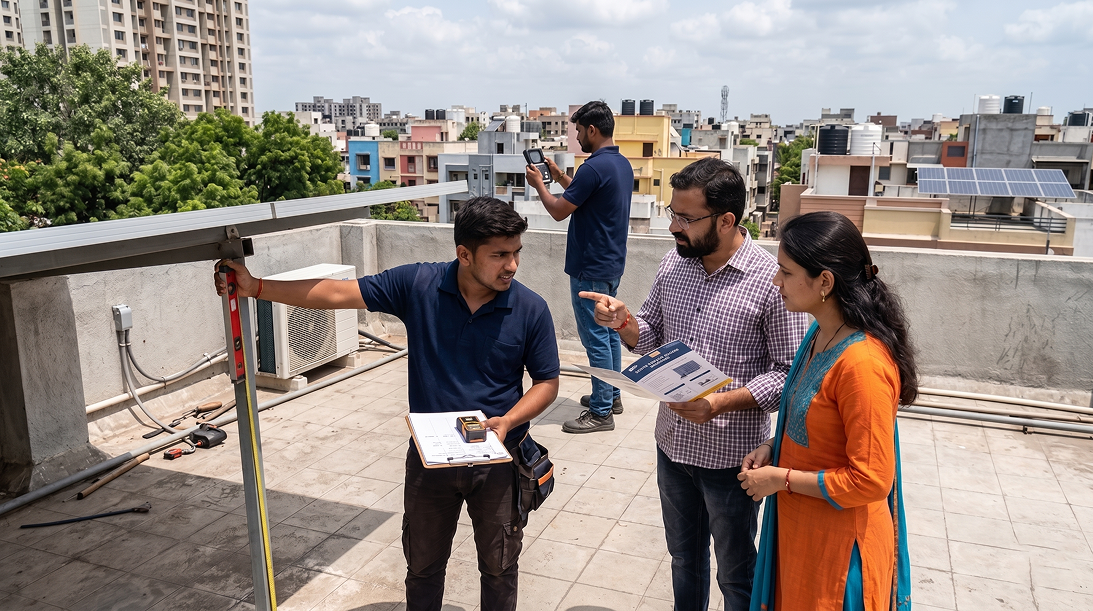
After-sales service has moved from an afterthought to a primary purchase criterion. Site surveys have become a baseline expectation – assessing roof structure, shading patterns, orientation, and load profile before any system is sized or quoted. Buyers are rightly skeptical of quotations generated without one.

The Indian Reality

India’s conditions place genuine demands on solar equipment. Summers across Rajasthan, Gujarat, and central India push panel temperatures well beyond standard test conditions. Dust accumulation across northern and western India degrades output between cleaning cycles. Monsoon humidity, coastal salt air, and industrial rooftop environments create durability requirements that cheaper equipment frequently fails to meet across a decade of operation.

Rising electricity tariffs make the financial stakes of underperformance higher every year – meaning the cost of a poor solar decision compounds over time just as surely as the savings from a good one.

The Long-Term Financial Reality

The comparison that matters is not the upfront quotation – it is the cost per unit of electricity generated over 25 years. A system costing 15% more upfront but delivering 20% more cumulative generation with fewer maintenance interventions is significantly better value by any rational measure.

Smart buyers are beginning to run these numbers rather than simply comparing installation quotes. Those who do almost always conclude that quality-driven decisions outperform price-driven ones over any realistic project horizon.

Conclusion

The cheapest solar system is rarely the most economical one. The real measure of a good solar investment is long-term performance, reliable service, and a system designed honestly for the site it serves – not the lowest price per watt or the highest panel count on a quotation.

Ask better questions. Expect proper answers. Choose quality where it compounds over time.

Frequently Asked Questions

Does a higher kW system always mean higher savings?

Not necessarily. Sizing must match actual consumption and rooftop conditions. Oversized systems on poorly surveyed rooftops frequently underperform smaller, well-designed ones.

What degradation rate should quality panels maintain?

Reputable manufacturers guarantee no more than 0.5% to 0.7% per year. Lower-grade panels often degrade faster, significantly impacting long-term generation.

How important is inverter brand?

Very. The inverter is the most failure-prone component in most systems. A reliable brand with strong local service directly affects uptime and long-term performance.

What should a proper site survey include?

Roof structure assessment, shading analysis, orientation and tilt evaluation, and a review of your actual electricity consumption pattern.

How do I evaluate warranty terms?

Check what is covered, for how long, and whether the company has a credible local presence to actually honour claims. A 25-year warranty from a company with no service infrastructure is worth very little.

How do I compare quotations fairly?

Compare projected lifetime generation cost per kWh, not just upfront price per watt. Factor in panel quality, inverter brand, warranty terms, and service commitment alongside the number.

RELATED POSTS

How Ish Solar Harvests Energy from the Colors You Can’t See

How Ish Solar Harvests Energy from the Colors You Can’t See

In the entire universe, the Sun is the only planet that will continue to shed important rays on the Earth and other planets. Speaking specifically about Earth, the Sun is an important planet that provides energy to all living things on Earth. The sun’s rays are usually yellow and white in color, but along with the sun, ultraviolet rays also fall on the earth, which are usually not visible to the naked eye.

How Ish Solar Gives You 30% More Free Power The N-Type Bifacial Advantage

How Ish Solar Gives You 30% More Free Power: The N-Type Bifacial Advantage

Make some noise, you are in Ish Solar’s world. As people are turning to solar today, it is very important for them to be careful about which solar to choose. Most people are getting caught up in the cycle of cheapness and making their investment a failure. At first, they think that cheap solar will work, but let’s see. This type of solar panel initially lasts only three or four years, and over time, its efficiency becomes questionable.

How Ish Solar's Bifacial Technology Captures the Lost Energy of the Ground

How Ish Solar’s Bifacial Technology Captures the Lost Energy of the Ground

When you start any new business or adopt any new strategy, the profit expectation becomes 0. Among all these, solar is the only investment that can give you profit from day one. Suppose you started a business for a hundred rupees, will that business earn 130 rupees from the first day? We know your answer will be no. So it’s not too late. If you are still paying expensive electricity bills every month and killing your dreams, then Ish Solar is ready to get you out of this problem. So far, we have only seen that solar panels generate electricity from the top, that is, from direct sunlight. Instead of hitting the panels, thousands of sun rays hit the surrounding ground, roof surfaces, or sand, becoming waste. This is energy that no one has been able to capture until now.