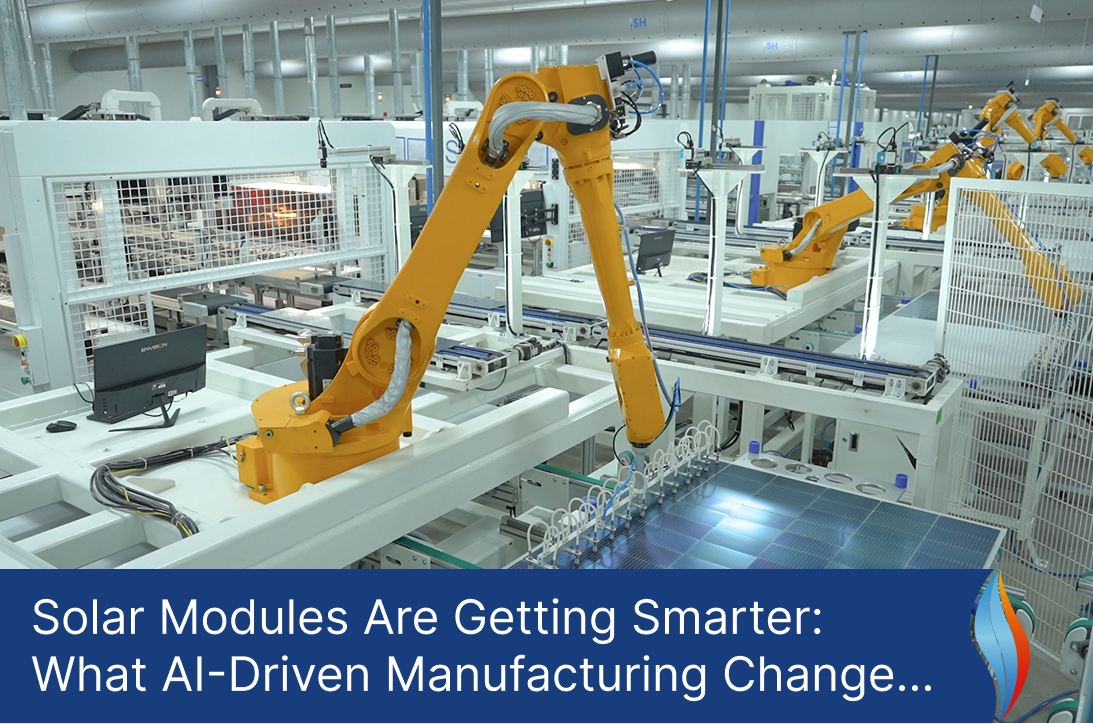
Solar Modules Are Getting Smarter: What AI-Driven Manufacturing Changes Before a Panel Reaches the Field

Most solar problems that show up in year five were created in the factory. A weak solder joint, a hairline crack in a cell or a mismatched pair of cells in a string can pass a quick check and still cost energy for the next twenty-five years. AI-driven manufacturing exists to catch those problems early and keep them from repeating. It is also why ISH Solar has put AI-driven precision at the center of its production.

The Datasheet Is Only as Good as the Production Line

A module is built in stages: cell production, sorting, stringing, lamination, framing and final testing. Each stage hands its small errors to the next one. A cell with slightly lower current drags down the whole string it sits in. A micro-crack that is invisible to the eye can grow with every thermal cycle.

Manual inspection and batch sampling were built for smaller volumes. At gigawatt scale, a defect rate that looks tiny on paper still means thousands of panels that will never match their rated output. ISH Solar's focus on consistent product quality starts from exactly this point: the line itself.

Where AI Earns Its Place on a Module Line

Inspection

Inspection:

Vision systems trained on defect patterns check every cell and every module, not a sample. They pick up micro-cracks, soldering flaws and misalignment that tired eyes miss.

Cell matching

Cell matching:

Sorting cells into tight performance groups keeps strings balanced, which protects output and reduces hot-spot risk.

Process control

Process control:

Data from each stage lets the line correct itself in real time instead of waiting for a failed batch. ISH Solar's AI-driven processes follow the same logic.

Traceability:

When a fault does appear, production data points back to the stage and settings behind it.
Why TOPCon Raises the Stakes

N-Type TOPCon cells are efficient because of their thin, carefully engineered layers. That same design leaves little room for process drift. A small variation in a deposition or firing step can change cell behavior, so the tighter the control, the more of the cell's potential reaches the field.

Precision at Gigawatt Scale: Smarter Production at ISH Solar

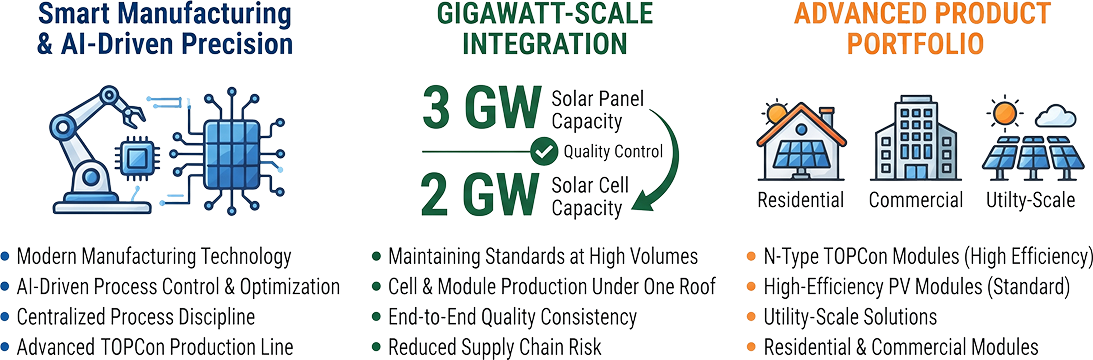
As an Indian module and cell manufacturer, ISH Solar pairs modern manufacturing technology with AI-driven precision, and its focus on advanced TOPCon technology means process discipline sits at the center of the plant.

Scale makes that discipline harder, and more valuable. With 2 GW of solar panel capacity and 1 GW of solar cell capacity, ISH Solar has to hold the same standard across very large volumes. Making both cells and modules also lets ISH Solar carry quality standards across more of the production chain, from the cell to the finished panel.

The output is a range that includes N-Type TOPCon modules, high-efficiency PV modules, utility-scale modules, and residential and commercial modules.

Precision at Gigawatt Scale Smarter Production at ISH Solar

What Buyers Can Actually Check

Three things are worth checking with any supplier.

Degradation:

Ask for first-year and annual degradation figures. ISH Solar modules are designed for low first-year degradation and low annual degradation over 30 years.

Warranty:

Look for a linear power output warranty alongside a product warranty. ISH Solar modules carry both.

Field behavior

Field behavior:

Consistent generation across heat, dust and humidity is what counts. ISH Solar modules are built for consistent power generation under diverse environmental conditions.

The Takeaway

A good panel is a series of small decisions made correctly, thousands of times over. ISH Solar treats innovation, quality and reliability as production habits, backed by continuous product improvement and sustainable manufacturing practices. As Made in India module manufacturing grows, that discipline will define which panels hold up in the field.

Frequently Asked Questions (FAQs)

What does AI-driven manufacturing mean in solar?

It means using data and intelligent automation to inspect, control and improve each production step, so modules are more consistent and defects are caught earlier.

Can manufacturing quality really affect long-term output?

Yes. Micro-cracks, mismatched cells and weak bonds reduce output and speed up degradation. Consistent production keeps a module close to its rated performance for longer.

How does ISH Solar use AI in manufacturing?

ISH Solar combines modern manufacturing technologies with AI-driven precision, supported by advanced production technology and high manufacturing standards, to keep quality consistent.

What is ISH Solar's manufacturing capacity?

ISH Solar has 2 GW of solar panel manufacturing capacity and 1 GW of solar cell manufacturing capacity.

Which modules does ISH Solar manufacture?

ISH Solar manufactures N-Type TOPCon modules, high-efficiency PV modules, utility-scale modules, and residential and commercial modules.

What warranty do ISH Solar modules carry?

ISH Solar modules carry a linear power output warranty and a product warranty, with low first-year degradation and low annual degradation over 30 years.

RELATED POSTS

Solar Panels Alone Don't Create Sustainability - Smart Planning Does-featured

Solar Panels Alone Don’t Create Sustainability – Smart Planning Does

A warehouse owner in Pune installed a 150 kW rooftop solar system two years ago. Savings looked great on paper. Installation happened fast. Nobody spent much time on the roof beforehand. Within eighteen months, panels had hot spots, the roof was leaking around brackets, and output was 22% below projections.

More Panels, Lower Price - But Is It Actually a Better Deal-featured

More Panels, Lower Price – But Is It Actually a Better Deal?

You have three solar quotations in front of you. One offers 10 kW for a price that seems almost too good. Another proposes 8 kW from a brand you recognise, with a longer warranty and a proper site survey included. The third is somewhere in the middle – more panels, vague warranty terms, and a salesperson emphasising system size over actual generation.