


Made in India, But Made From What? Tracing the Hidden Imports Behind Solar Modules

A solar module can be made in India and still contain imported parts. Assembly is only the last step of a longer chain, and the earlier steps, from silicon to wafers to cells, have leaned heavily on imports. Most buyers never see those steps. They matter, because they shape how secure, traceable and price-stable the panel on your roof really is.

Four Steps Between Sand and Sunlight

A solar module is the last link in a longer chain.

Polysilicon

Purified silicon is the raw base of almost every panel. TERI's January 2026 report says India imports nearly all of its polysilicon.

Ingots and wafers

Silicon is crystallised into ingots and sliced into thin wafers. The same report puts wafer imports at about 90%.

Cells

Wafers become cells, the part that actually turns sunlight into electricity. This is where India is building capacity now.

Modules

Cells are wired, laminated and framed into the panel you see on a roof. This is where India is strongest.

Strong at the Top, Thin at the Base

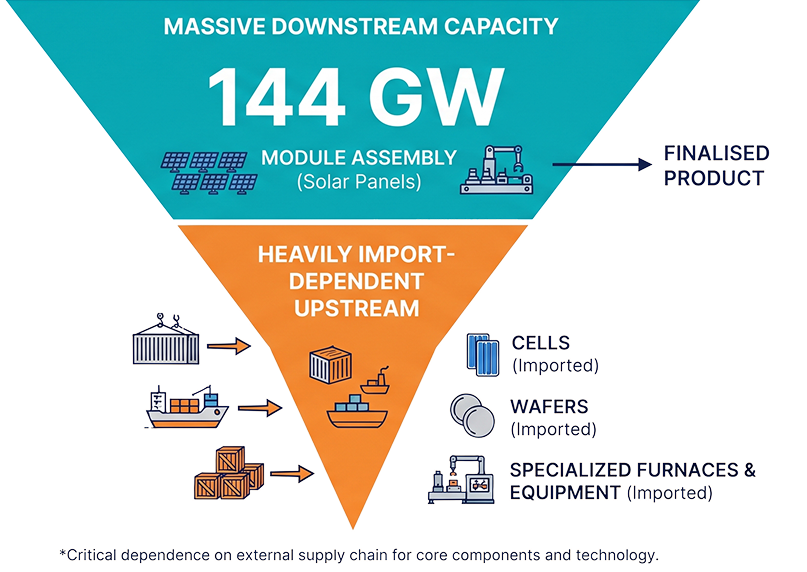
TERI's January 2026 report counted about 144 GW a year of module capacity in India and described it as well above domestic annual demand. Assembly has clearly scaled. But a factory that assembles panels from imported cells and wafers can be exposed to global price changes, shipping disruptions and trade-policy shifts. The report adds that over 90% of the specialised furnaces and cell-coating tools used upstream are imported as well. The harder work now sits upstream.

How Policy Is Pulling the Chain Home

MNRE's ALMM List-II, which covers solar cells, became applicable from 1 June 2026. It applies to covered projects such as government-backed, net-metered and open-access systems, but exemptions and clarifications apply, including for some projects bid before the cut-off. List-III is set to extend the requirement to ingots and wafers from 1 June 2028, and covered projects bid before a cut-off tied to the first wafer list stay exempt whatever their commissioning date.

What to Ask Before You Buy

Origin is a fair question, and any good supplier will answer it.

Where ISH Solar Sits in the Chain

ISH Solar manufactures solar cells and solar modules in India, which puts two of those four steps in its own hands. That does not mean every upstream material is sourced domestically. Its AI-driven manufacturing aims for consistent quality, and its N-Type TOPCon modules are built for residential, commercial, industrial and utility-scale projects, with low degradation and a linear power output warranty. ISH Solar's modules are also ALMM-enlisted. Wafers and polysilicon are stages India as a whole is still building, so questions about origin belong in every buyer conversation, ISH Solar's included.

The Label Is Only the Start

"Made in India" is the beginning of the story, not the end of it. India has built the factories. The cells, wafers and polysilicon behind them are the next chapters, and buyers who ask where their panel's parts came from help push that work forward. ISH Solar welcomes those questions.

Frequently Asked Questions (FAQs)

Does "Made in India" mean every part is made in India?

No. The label usually describes where the panel was manufactured or assembled. TERI estimates India still imports most of its wafers and nearly all of its polysilicon.

Does ISH Solar manufacture solar cells in India?

Yes. ISH Solar manufactures both solar cells and solar modules in India, though not every upstream material is domestic.

Which technology do ISH Solar modules use?

N-Type TOPCon, with product ranges for residential, commercial and utility-scale use.

Are ISH Solar modules ALMM-enlisted?

Yes. ISH Solar announced its enlistment under MNRE’s ALMM for solar PV modules in July 2026.

What should I ask any supplier about origin?

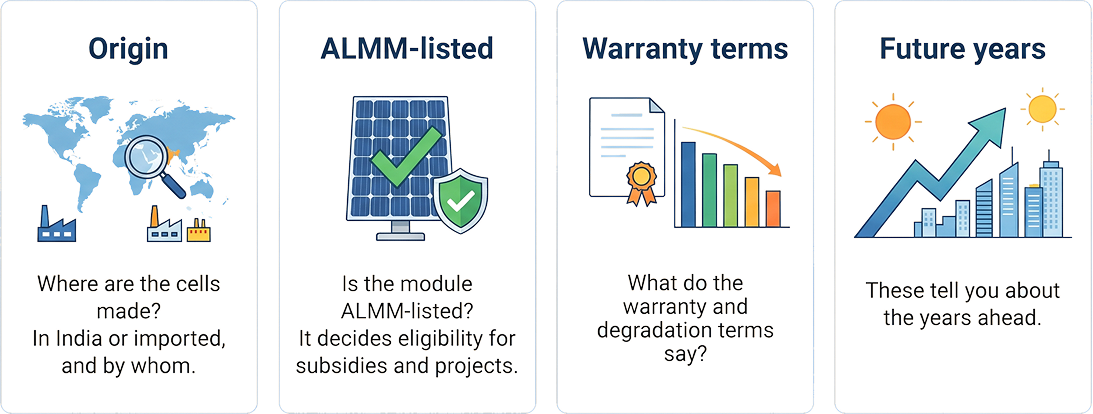
Ask where the cells are made, whether the module is ALMM-listed and what the warranty and degradation terms say.

RELATED POSTS

How Ish Solar N-Type Modules Protect Your Grandchildren's Inheritance-featured

How Ish Solar N-Type Modules Protect Your Grandchildren’s Inheritance

In Gujarat families, we plan for the long haul—whether it’s growing a business across generations or securing a home that lasts. Solar fits perfectly into that vision. Ish Solar’s N-Type modules aren’t just about today’s bills; they’re a 30-year commitment to reliable power that your grandchildren will thank you for.
Powering Stability How BESS Is Redefining Modern Solar Energy Systems-featured

Powering Stability: How BESS Is Redefining Modern Solar Energy Systems

Solar energy adoption in India is growing at a remarkable pace. Falling installation costs, rising electricity tariffs, and stronger environmental awareness have pushed homes, businesses, and industries toward rooftop and ground-mounted solar systems. Yet despite this progress, one fundamental challenge remains: solar power is intermittent. It generates electricity when the sun shines and stops when it doesn’t.