The Back of a Solar Panel Is Doing More Work Than You Think: Understanding the Real Potential of Bifacial Modules

For decades, the rear of a solar panel was just a protective layer. Bifacial modules changed that. By collecting light on both faces, they turn the ground, the roof and the surrounding space into part of the power plant. The idea is simple, but the real gain depends on how a project is designed, and that is where manufacturers like ISH Solar, whose ISH Supreme and ISH Prime modules are both bifacial, keep their attention.

How a Bifacial Module Works

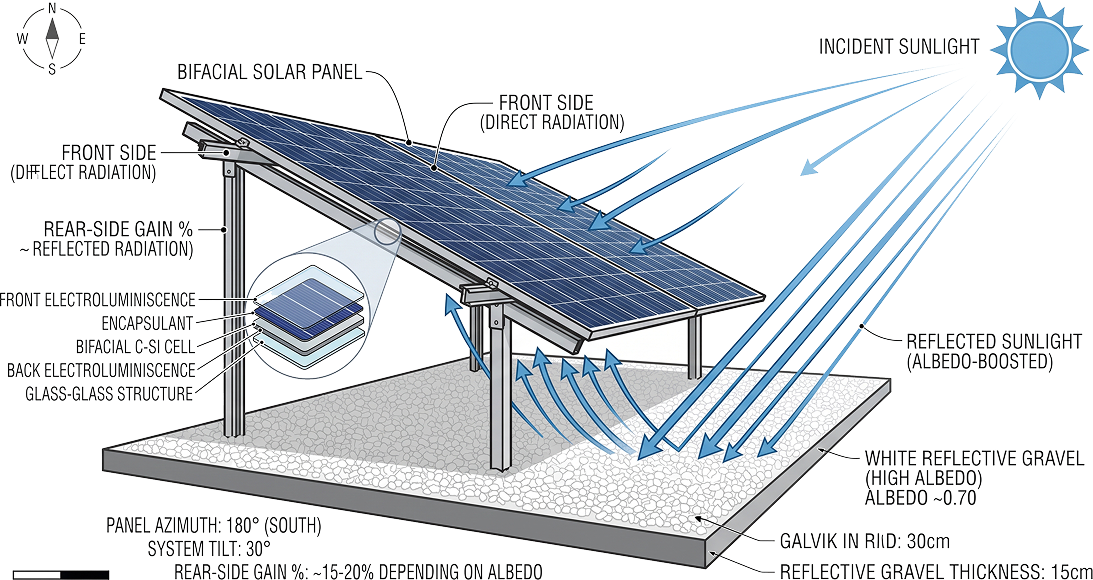
A conventional module generates power only from sunlight hitting its front. A bifacial module also captures light that reaches the back: sunlight reflected off the ground, plus diffuse light scattered from the sky and nearby surfaces. Both faces feed the same cells, so the module delivers more energy from the same footprint. Dual-glass construction is common in bifacial designs and adds durability.

What Decides the Rear-Side Gain

The extra energy is never a fixed number. It changes from site to site.

What Decides the Rear-Side Gain

Where AI Earns Its Place on a Module Line

Ground surface:

Light, reflective ground such as white gravel or pale concrete sends much more light to the rear than dark soil or dense vegetation.

Mounting height:

The higher a module sits above the ground, the more evenly its rear receives light.

Tilt and row spacing:

Wider spacing lets reflected light reach the back of each row instead of being blocked by the next.

Structure shading:

Rails, cable routing and the junction box can cast shadows on the rear, so layout details matter.

Where Bifacial Makes the Most Sense

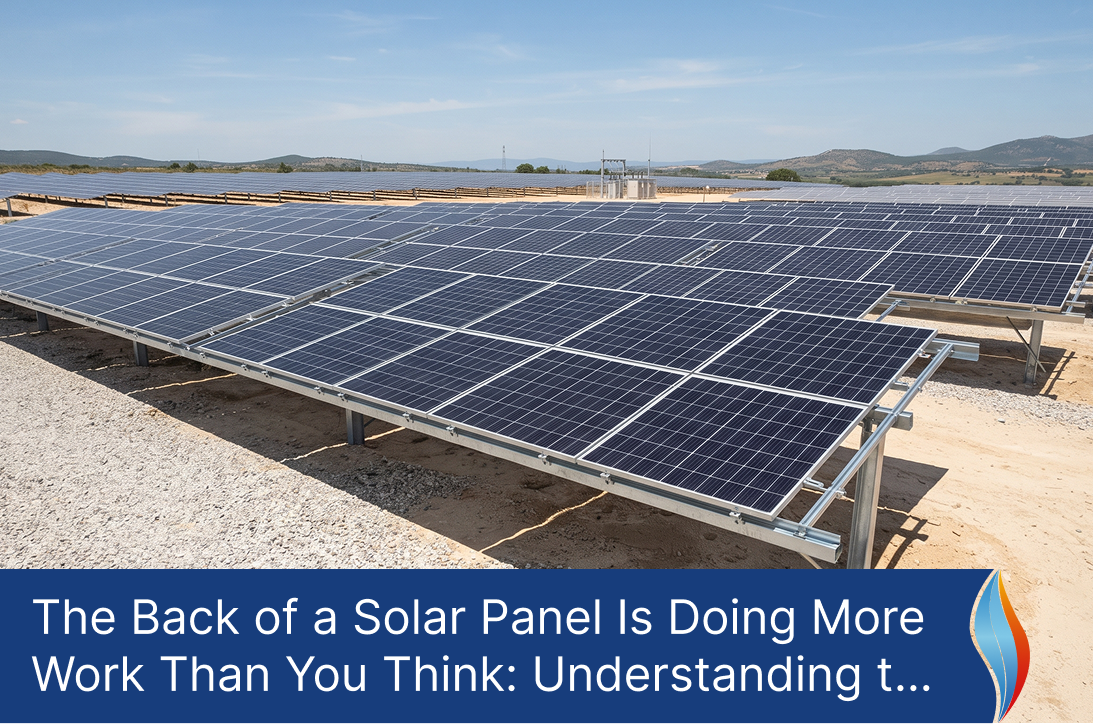
Ground-mounted solar farms are the natural fit. Modules sit high, rows are spaced deliberately and the ground can be managed. Commercial and industrial flat roofs with light-colored surfaces can also benefit when modules are tilted and raised. On a typical pitched residential roof, where panels sit close to a dark surface, the rear gain is modest.

Why Cell Technology Matters Even More

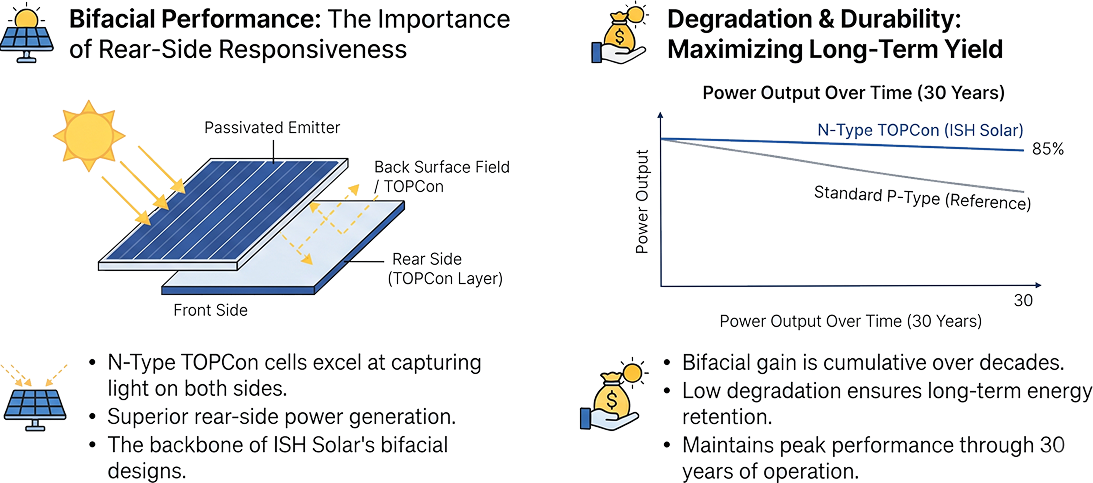
A bifacial module is only as good as the cell behind it. N-Type TOPCon cells respond well to light on the rear face, which is why TOPCon is a common base for bifacial designs, and why ISH Solar builds its range on it. Degradation matters just as much. Rear-side gain adds up year after year, so a module that holds its output over three decades keeps that extra energy working for longer.

Why Cell Technology Matters Even More

Why ISH Solar's Bifacial TOPCon Suits Large Projects

ISH Solar's bifacial range pairs N-Type TOPCon cells with dual-glass construction. ISH Supreme, rated 610-650 WP and built on G12R technology, is aimed at utility-scale, industrial and large rooftop installations, where mounting height and row spacing can be planned to favor the rear side. ISH Prime, rated 480-500 WP and built on M10R technology, brings bifacial TOPCon to residential, commercial and industrial projects.

Consistency counts as well. In a large array, modules that behave alike keep strings balanced and make performance easier to predict. ISH Solar's AI-driven precision manufacturing is aimed at that consistency. ISH Solar modules are designed for low first-year degradation and low annual degradation over 30 years, backed by a linear power output warranty and a product warranty.

What to Ask Before Choosing

Cell technology:

Is it N-Type TOPCon or an older design?

Construction:

Is the module dual-glass for long-term durability?

Degradation:

What are the first-year and annual figures?

Warranty

Warranty:

Does a linear power output warranty back the module?

Site modeling

Site modeling:

Has the supplier accounted for your ground reflectivity, tilt and row spacing?

The Takeaway

Rear-side energy is real, but it is earned through site design, careful layout and module quality. Innovation, quality and reliability sit at the core of ISH Solar's manufacturing philosophy.

Frequently Asked Questions (FAQs)

What is a bifacial solar module?

It is a module that generates power from both its front and rear faces, using direct sunlight on the front and reflected or diffuse light on the back.

How much extra energy does the rear side add?

It depends on the site. Ground reflectivity, mounting height, tilt and row spacing all change the result, so projects should be modeled individually.

Are ISH Solar modules bifacial?

Yes. ISH Supreme and ISH Prime are both N-Type TOPCon bifacial modules with dual-glass construction.

Which ISH Solar module suits which project?

ISH Supreme (610-650 WP) targets utility-scale, industrial and large rooftop installations. ISH Prime (480-500 WP) suits residential, commercial and industrial applications.

Does ISH Solar supply modules for ground-mounted projects?

Yes. ISH Solar provides solar solutions for ground-mounted projects, including utility-scale installations and large solar farms.

What warranty do ISH Solar modules carry?

ISH Solar modules carry a linear power output warranty and a product warranty, with low first-year degradation and low annual degradation over 30 years.

RELATED POSTS

Best Solar Manufacturing Company in Gujarat Why Choose Ish Solar-featured

Best Solar Manufacturing Company in Gujarat: Why Choose Ish Solar?

A big mistake many people make before installing solar is choosing a local solar company. The main reason behind this may be that when you visit any solar company, they lure you in by showing you false figures from pamphlets or brochures. Usually people make such mistakes and end up regretting them. Dil Se Ne Digna In today’s time, the use of solar power is increasing and there are a large number of solar companies in the market. But in such a competitive market, if you are thinking of installing solar, then you should be aware. While the government is also providing subsidies to people to install solar today, people in most countries of the world are turning to installing solar. Now the question arises that among so many solar companies, which company is the best for us? When you buy a household item or small item, raw materials are fine, but you should be careful when it comes to choosing solar power. A solar system is a valuable investment for you for the next 25 years. We don’t have to invest in it over and over again.
Powering Stability How BESS Is Redefining Modern Solar Energy Systems-featured

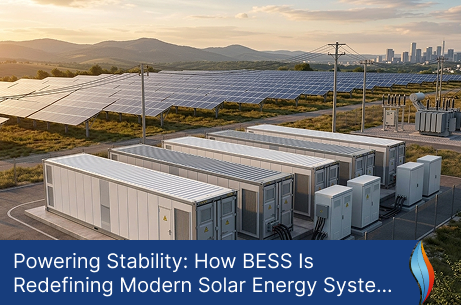
Powering Stability: How BESS Is Redefining Modern Solar Energy Systems

Solar energy adoption in India is growing at a remarkable pace. Falling installation costs, rising electricity tariffs, and stronger environmental awareness have pushed homes, businesses, and industries toward rooftop and ground-mounted solar systems. Yet despite this progress, one fundamental challenge remains: solar power is intermittent. It generates electricity when the sun shines and stops when it doesn’t.